Justin Bieber Didn't Need a Stage. He Needed a Stream.

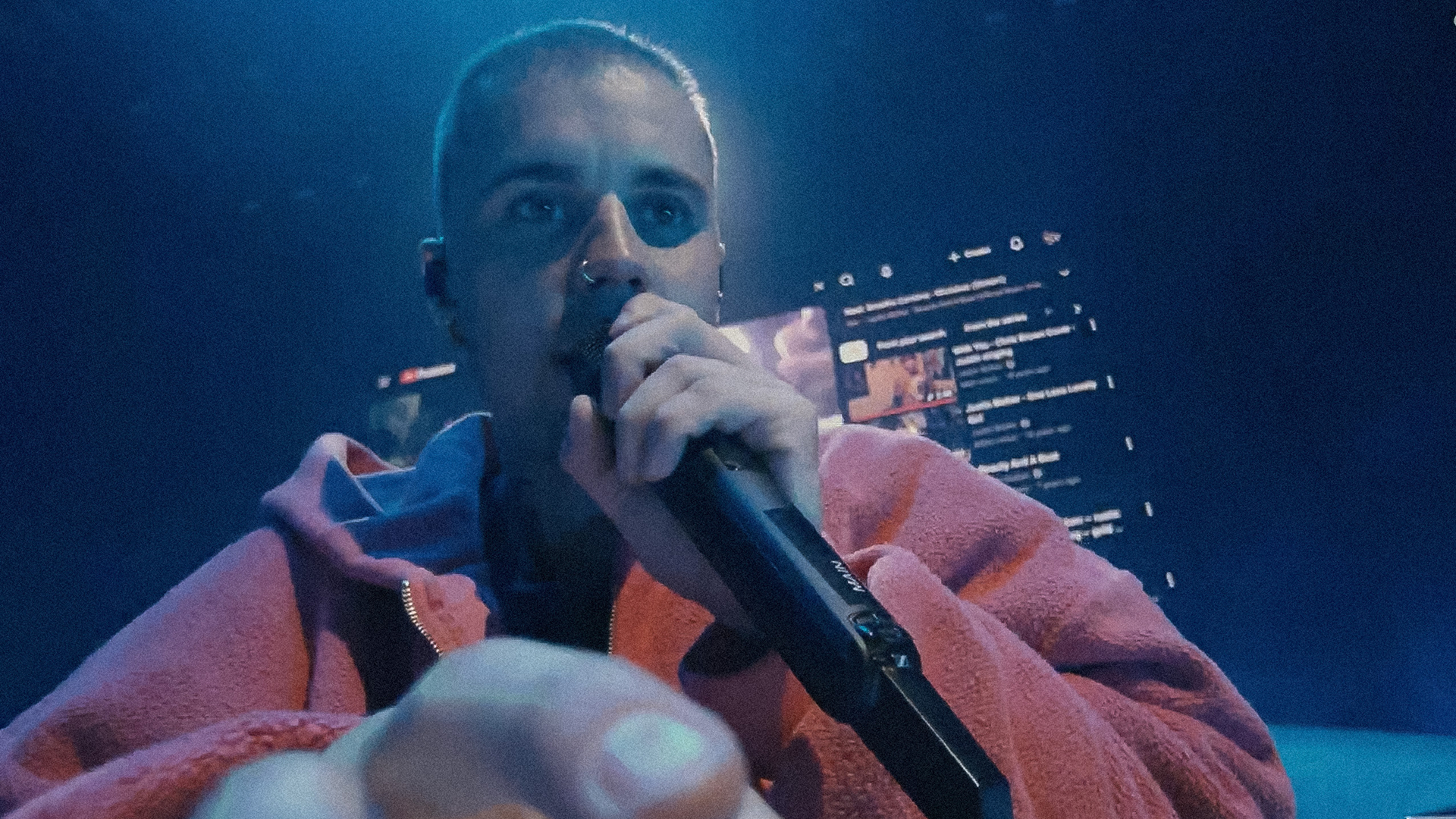
Justin Bieber made his comeback last weekend at Coachella. The whole thing was a particularly intimate affair, with Bieber himself clad in his usual comfy sweats, no props or backdrop necessary. Festival goers clambered among one another, some choosing to sit out in front of the main stage the moment the Coachella Day 2 doors opened, in hopes of being eye-line with the pop-star himself.
Though, despite the desire (of probably every single festival goer) to have an eyeline moment with Bieber, it was actually the fans at home that got a unique experience of the performance, with the minimalist vibe, an attempt to foster intimacy, not just with Coachella Beliebers, but those watching and commenting worldwide too.
Bieber's affinity for the simple, minimal self-made aesthetic didn’t convince everyone, with some viewers hoping for a ‘Sabrina Carpenter-esque’ performance, complete with a set and back-up dancers. However, Bieber’s commitment to the understated isn’t rooted in laziness, but rather in his history, as a self-made singer.
If you think about it - Justin Bieber is one of the first ‘social-media creators’ turned singers. Though, back in 2008, the creator economy did look substantially different. There was no strategy behind content, it was completely stripped back - creators created whatever they wanted to - and rarely were they searching for any kind of fame.
This process changed considerably when Justin Bieber created his channel Kidrauhl in the late 2000s. Here, he would upload his 14-year old self singing covers while living his day-to-day life, brushing his teeth or hanging out with friends. It wasn’t until Scooter Braun discovered and subsequently co-signed him with Usher in 2008, that his online presence would turn him into one of the world’s most famous pop-stars.
He is, in many ways, proof of concept for the entire creator economy. His rise rewrote the rules of what fame could look like - and, whether it was known at the time or not, a new era of marketing was born. From his very inception, Bieber curated his own image, and though this may have changed during his teenage pop-star era, the idea that a normal person could build an audience organically, was something entirely new.
This is perhaps why his Coachella set felt so coherent. It spoke to his story - the one that started with him at home, in front of a camera, talking to his fans. It acted almost as an antithesis to the excess that Coachella can often be associated with. It was a chance for him to tell his own, authentic life story - this is what made it so successful.
So, what can be learned from JB’s Coachella performance? I suppose the most important message, as cliche as it sounds, is that authenticity matters. Justin Bieber didn’t need the flashiness because his narrative did the work itself. Flashiness with no depth feels hollow and rarely leads to audience engagement. What’s important then, is that creators create content and establish brand relationships that feel authentic, not forced. Where once engagement may have come from aspiration, it now comes from recognition. If viewers no longer relate to a creator - their brand image suffers massively.
For brands, this reframes what a valuable creator partnership may look like. The creators worth investing in aren’t necessarily always the ones with the highest production values or the most followers but the ones who have a genuine point of view and an audience that trusts them. Scooter Braun took that chance on Justin Bieber back in 2008 because he saw genuine talent, and to him, that was enough to build a trusting and properly engaged audience.
For brands and creators alike, that's the standard worth chasing. An audience that trusts you is worth more than an audience that simply sees you. Bieber built that trust in a bedroom on YouTube, and last weekend, seventy thousand people queued up to prove it still holds.
MORE FROM THE FEED
UNLEASH THE POWER OF CREATOR